You are browsing the archive for | Egypt on Indie Travel Podcast.

Guidebook Review: Cadogan Guide to Egypt

May 5, 2011 in Egypt

Far be it from me to diss travel writers–after all, I am one, as are my hosts here at Indie Travel Podcast.  However, I must honestly say that the Cadogan Guides appeal to me because specialists write them.  You never get the feeling as you do with some guidebooks, that the author of a Cadogan Guide just dropped in to survey the high spots.

It is hard to imagine a better-qualified guide than Michael Haag, author of the Cadogan Guide to Egypt and to Cairo.  Haag has written several other books about Egyptian cities, and as you read the Egypt one, it is clear that he knows his territory well.

Like all Cadogan guidebooks, Egypt strikes me as opinionated but accurate, and full of delightful surprises. I read the fourth edition of Egypt (2009), and they published the third edition of Cairo in 2010. Given recent events, it is fair to assume they will revise these before long, but most of the information is timeless. In explaining the “totality of their history”, which stretches over 7,000 years, Haag progresses through Pharonic, Arab, Christian and Modern Egypt.

Siwa oasis Egypt

The Siwa Oasis viewed from a fortress

Some of the most practical information in a guidebook occupies the front and the back of the book.  Here the introduction gives a quick list of high points for each of the important periods and suggested itineraries for a week or two weeks. In the back of the book, I want a guidebook to have a good index, further reading, a bit about the language; and the Cadogan Guide has all of these, plus a glossary that includes illustrations of architectural details. Note: you need to go elsewhere for a comprehensive list of hotels and restaurants.

If I were to go to Egypt, I would be particularly eager to follow in the footsteps of Alexander down the Nile to Alexandria. Haag has written other books on the city of Alexandria, so the book is very strong in this section. You must use your imagination to see Alexander’s or Cleopatra’s city, but the 19th and 20th century city inhabited by Constantine Cavafy and Lawrence Durrell survives. “…the departed cast of this more recent Alexandria joins the ghostly pageant, haunting the cafes, barber shop, hotels and apartments of a gently disintegrating stage set,” Haag says.

Alexandria, Egypt from the beach

A sideways view of Alexandria, Egypt

I would love to go to Siwa oasis, a place written about with relish by Herodotus, partly because of its interesting sexual history. Today known as a magnet for gay travel, Siwa was the home of an oracle consulted by Alexander, who requested to be buried there.   He was eventually buried in Alexandria in a spot no longer known.

The Temple of Ammon(Amun) at Siwa, says Haag, “…is so small you can be certain of standing exactly on the spot where Alexander himself stood 2,300 odd years ago.” (Pumping fist in air: “YES!!”)

Interlink Books, the U.S. publisher of the Cadogan Guides, provided a review copy of this book.

Travel photo: Pyramids of Cairo, Egypt

February 4, 2011 in Egypt

Travel photo: Pyramids of Cairo, Egypt

Travel photo of the pyramids in the mist in Cairo, Egypt.

Visit Egypt’s pyramids with an audio guide

November 23, 2010 in Egypt

I really enjoy listening to travel podcasts while I’m on the go, around the world. There’s an abundance of talk shows, opinions and destination-based podcasts that fill my ipod, along with a selection of historical, cultural and socio-religious shows that help me understand the depth of the world around me.

For all the hours of audio I consume each week, I’ve never really taken the time to listen to audio guides on places I’m planning to visit, or the locations I’m at. That changed when Ben from Iconic Guides emailed me to try his travel audio guides to Japan, Egypt and Greece.

I jumped at the chance to hear a series on the step pyramid of Djoser, which I knew nothing about. I downloaded a series of eight mp3s and dropped them onto my iPod.

Listening to Djoser

In the end I listened to them in Norway, as we were heading to Selbu. There was something surreal about winding my way along lush green valleys, forests dropping down to the glacial lakes, while imagining a dry and dusty world, with sand stretching from the steps of the pyramid complex.

The imagined world was quite complete, however: background information, historical detail and architectural style all combined to make for an entertaining and informative listen. Doing this as a pre-visit exercise was really good; it gave me an idea of what to expect, what to look out for, and gave me a few leads on other areas of knowledge I’d like to know about before arrival.

Pre-trip research, on the ground guidance

I don’t know about you — perhaps you take the time to do some background reading before you arrive somewhere — but I often try to find out about a place when I’m actually there. I tend to read up on places I’ve been (to help me understand my impressions) rather than places I’m going. Listening to my Iconic Guide, however, led me down the path of research as I wanted to understand more about the social structure and the empires of the Nile and Middle East in the time these pyramids were built.

There were elements pointed out, like a particular piece of the building, and I would have liked to have been there to see it. I have no doubt that listening to these on the flight to Egypt then again once you’re at the complex will add a lot to your visit. If you’ve used Iconic Guides at any of their destinations, let us know in the comments below.

The audio travel guides have been produced to a high standard, but I must admit the voice actor drives me a bit crazy with a stilted delivery that is easy to understand at the detriment of natural intonation and conversational flow; there’s a touch of a Standard BBC Accent in training. Getting past this did take me some time, but the information in the guide was certainly worth it, being clearly presented, well written and interesting.

The series of guides currently comprises shows on Egypt, Greece and Japan. You can find them at Iconic Guides.

Audio guides to give away

Iconic Guides has given two Indie Travel Podcast listeners the chance to win a set of five audio guides (excluding Iconic’s “bundles”). You can choose from any location in Egypt, Greece and Japan. Visit Iconic Guides to see the destinations they currently cover. Your audio files will be emailed to you, or sent on a CD if you prefer. 

To win, simply leave a comment below before November 30 (we’ll close it off at midnight EST). We’d like to know two things: a) Which of the Iconic Guides would you most like to hear, and b) what cultural sites or destinations would you like to see covered in an audio guide? This could be anywhere in the world. We’ll choose two winners at random and email you with more details.

There’s more than three pyramids in Egypt. Really.

August 24, 2010 in Egypt

It is not always immediately apparent to visitors to the pyramids of Giza that these ‘Wonders of the Ancient World’ were, in fact, the culmination of years of intense developments in royal tomb design – part of a tradition of pyramid building in ancient Egypt that spanned several millennia.

Saqqara: the dawn of the Pyramid Age

The birth of pyramid design actually began with the appearance of Djoser’s step-pyramid complex at Saqqara (c. 2667 – 2648 BC). His stunning mortuary complex contains the world’s first monumental buildings in stone, including a sophisticated collection of elegantly designed hallways, shrines and open courtyards.

At the centerpiece of this architectural tour de force was the tomb of the king – the Step Pyramid. This was a radically new style of building and the foundation for the transition from earlier royal mastaba (or bench-like) tombs to the true pyramid forms that would later appear in the 4th dynasty (2613 – 2494 BC).

Djoser had originally intended to build for himself a large stone-built mastaba. However, for reasons unknown to us, he continued to expand the structure with the addition of a second smaller mastaba, built on top of the first. This process was repeated until the building took on its final form – that of a six-stepped pyramid – without doubt, a truly brilliant piece of engineering.

Sneferu, Master Pyramid Builder

Thirty-five years after Djoser’s death, king Sneferu came to the throne as head of a new line of 4th dynasty monarchs (r. 2613 – 2589 BC). He quickly set about a prodigious and highly innovative campaign of pyramid building that included no fewer than three monumental pyramid-tombs, one at Meidum and two at Dahshur. His feats as a monumental builder are remarkable. In fact, the stone used in his three funerary complexes surpasses the amount employed by Khufu in the “Great Pyramid” at Giza.

Mistakes at Meidum

Whilst the vast necropolis of Saqqara is high on the list of most tour groups, very few tourists have time to visit Meidum, some 100 kms south of Cairo. It was here that Sneferu built his first pyramid. Originally conceived as a seven-stepped, and then an eight-stepped monument, it drew its inspiration from the blueprint set down by Djoser. Whilst the structure has partially collapsed (probably in antiquity), it still dominates the desert landscape for miles around. A visit to Meidum will be rewarded by gaining entry into the core of the pyramid and the rather uncomfortable, though hugely exciting, descent to the otherworldly burial chamber of the king.

The move to Dahshur

Upon completion of his Meidum step-pyramid, the complex was mysteriously abandoned when Sneferu re-located the imperial court from Meidum northwards to Dahshur, around the middle part of his reign. This would coincide with a dramatic shift in royal funerary architecture. For it was here at Dahshur, in the second half of the reign, that Sneferu’s architects would experiment with the construction of the first-ever “true” pyramids.

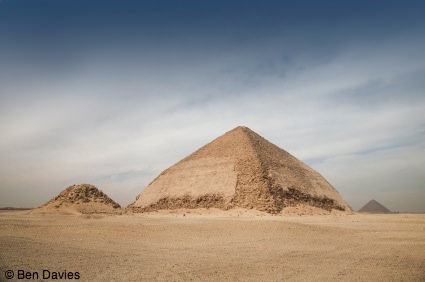
The Bent Pyramid: a flawed design

The first of Sneferu’s monuments here was the Bent pyramid, which marks his first attempt to make the transition from step pyramid to a true geometric pyramid. Greater emphasis on solar cults probably played an influential role in the new design. Upon death the king was believed to have been assimilated with the sun god. He joins the solar deity in his divine barque on a daily journey – a voyage that mirrors the cycle of the birth-death-and-resurrection of the sun god – and, by extension, the death and re-birth of the king himself.

Form following funerary function

The smooth sides of these new pyramids were styled to imitate the rays of the sun god – endowing the king with their divine, life-enhancing energy and thus providing him with a means to ascend to his final destiny. By ascending this ramp, the king would re-enact the main motif in the ancient perception of the afterlife – his eventual unification with the sun god in his daily journey through the heavens – a journey that would result in his own re-birth.

Third time lucky?

Unstable foundations meant that the Bent pyramid was plagued by structural difficulties and its angle of inclination had to be reduced midway through the build. It is this radical modification in design that is responsible for giving the pyramid its unique “bent” shape!

It was also at this point that Sneferu embarked upon a second, more ambitious pyramid, just to the north on the Dahshur plateau. This “Northern Pyramid” is more commonly known as the “Red Pyramid”, on account of the hue of its limestone core. With a base measuring some 220 metres, it is a mere 10 metres shorter than the “Great Pyramid” of Giza.

It is only in recent years that the site of Dahshur has been re-opened to the public and visitors allowed access to the inner chambers of the Red Pyramid. These fascinating, yet much neglected, monuments help to piece together our understanding of the technical advances in royal funerary architecture that took place between the construction of the first step-pyramid and that of the most famous pyramid of them all, the Great Pyramid of Khufu at Giza.

Travel photo: Luxor Temple, Valley of the Kings, Egypt

July 30, 2010 in Egypt

Egypt Travel Photo

Travel photo: Luxor Temple, Egypt

Egypt travel photo from the Valley of the Kings- Luxor Temple on the Nile River.

Travel photo: Aswan, Egypt

May 27, 2010 in Egypt

Travel photo: Aswan, Egypt

Solo female travel in Cairo, Egypt

May 26, 2010 in Egypt

On many travellers’ lists of must-see places in the world must surely be the pyramids of Giza in Cairo, Egypt. It is a place of many facets and visions, and for the solo traveller, especially female, the travel experience can be both fascinating and unfortunately uncomfortable in certain situations.

However, with some basic preparation, visiting Cairo can be an eye-opening and magical experience for the lone female traveller, as long as adequate research is done and you know what to expect.

Find other solo travellers to explore with

In all its flavour, Egypt is still a conservative country, and a single foreign female traveller will attract uncomfortable attention and unwanted assumptions. If you’re female and obviously from a western country, many men will think you’re available. To avoid being harrassed, it’s a good idea to locate other travel buddies to visit tourist spots together. Check out TravBuddy or Couchsurfing to find out who else is travelling alone and meet up for a day of exploration together.

Take the metro

Cairo has a great metro system that services all the main tourist attractions. The trains are cheap, fast and efficient, and the best part is, the middle two carriages are reserved for women only. Contrary to any negative premises, these special carriages are clean, seats are plentiful, and you don’t get hassled by men. For a guide to train travel in Egypt, have a look at Egypt Rail.

Walk the walk of terror

One of the first things you will notice about travelling around in Egypt is the lack of pedestrian crossings in general. Combine that with the abundance of 6-8 lane traffic constantly packed with whizzing vehicles, and you’re stuck. However, the locals seem to have grown immune to this and simply walk in front of or very close to traffic to cross the streets. This may sound crazy and dangerous to the average person, but there is usually no other way. A technique I developed was to discard all fear, and learn to walk alongside an Egyptian, and borrow some of their bravery as they cruise from one side to the other and miraculously survive time after time.

Don’t succumb to ‘baksheesh’

‘Baksheesh’ is the local term for ‘tips’. Unfortunately, although locals might sometimes seem helpful, it’s likely that they will expect you to give them money for their ‘advice’. It ranges from demanding to be paid for taking a picture of a camel, to asking for cash in exchange for road directions. Asking local women for information is worse, as they will just ignore you.

As a solo female traveller, the best way is to be prepared and know exactly where you want to go, and know what to expect at each touristy place you visit. If you do have questions or you’re not sure where to go, hop into a taxi. They are usually very cheap, and will probably cost you the same as ‘baksheesh’. Alternatively, stop at a restaurant for a meal and ask all your questions there.

Visit Maadi

If local flavour gets a tad overwhelming and you yearn for some home comforts, there is a little suburb named Maadi, which houses a large expat community with associated shops, food, and people. It’s not far from central Cairo, with a metro station, and is a haven for pubs, beer, and chips.

From the airport to the pyramids, Cairo can be fun and rewarding, and needs to be experienced with a big pinch of salt. Go on and bask in the glory of one of the wonders of the world. Just watch out for those touts and traffic.

Travel photo: Mohammed Ali Mosque, Cairo, Egypt

January 7, 2010 in Egypt

Travel photo: Mohammed Ali Mosque, Cairo, Egypt

Travel photo: Mohammed Ali Mosque, Cairo, Egypt

Also read:

Travel Photo – Giza, Egypt

July 2, 2009 in Egypt

Great Pryamid of Giza

Great Pryamid of Giza

England, Egypt and Italy (Travel Talks 09)

August 12, 2008 in Egypt, England, Italy

[Close Ad] Remove this ad! Log in or join the Indie Travel Podcast Community.